
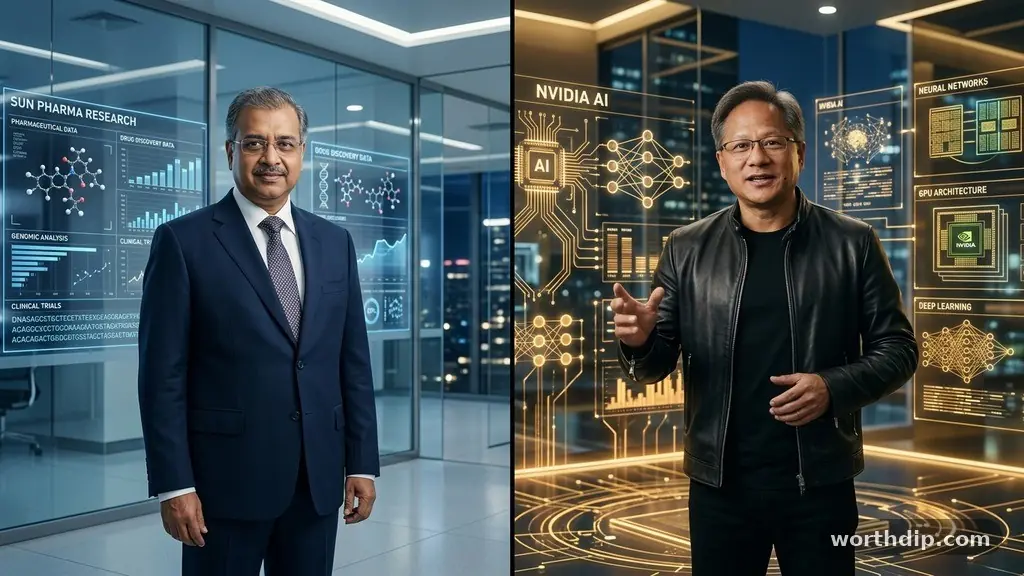
When comparing Dilip Shanghvi and Jensen Huang, you are looking at two distinct titans of modern enterprise. One transformed generic medicine production, while the other pioneered visual computing and artificial intelligence. This examination explores their parallel paths to immense wealth, examining how Dilip Shanghvi and Jensen Huang built their respective empires.
Financial Valuations and Wealth Comparisons
To understand the current standing of Dilip Shanghvi and Jensen Huang, we must look closely at their personal fortunes. Financial estimates fluctuate with global stock markets, but both men rank comfortably among the global elite.
Jensen Huang’s wealth skyrocketed alongside the market dominance of his semiconductor enterprise. Dilip Shanghvi accumulated his fortune through steady pharmaceutical expansion and strategic acquisitions.
Market valuations for these leaders depend heavily on share prices in their primary publicly traded corporations. When evaluating where they stand relative to other global billionaires, it helps to examine their primary financial metrics side by side. The table below outlines these figures based on recent market data.
| Leader | Primary Enterprise | Estimated Net Worth | Primary Industry |
|---|---|---|---|
| Jensen Huang | NVIDIA Corporation | Over $100 Billion | Semiconductors and AI |
| Dilip Shanghvi | Sun Pharmaceutical Industries | Over $20 Billion | Pharmaceuticals |
Jensen Huang owns a massive stake in the computing firm he co-founded in 1993. Most of his net worth ties directly to company stock performance.
Dilip Shanghvi holds his wealth primarily through founding stakes and family holdings in the pharmaceutical sector. Both men prove that long-term vision yields extraordinary financial results.
Early Beginnings and Educational Foundations
Jensen Huang was born in Tainan, Taiwan, in 1963 before moving to the United States as a child. He earned a degree in electrical engineering from Oregon State University.
Later, he completed a master’s degree at Stanford University. Those technical foundations allowed him to understand hardware architecture deeply before launching any commercial ventures.
Dilip Shanghvi entered the world in 1955 in Amreli, a small town in Gujarat, India. He grew up in a traditional business-oriented family environment.
He studied commerce at the University of Calcutta, graduating with a bachelor’s degree. His early exposure to wholesale drug distribution laid the groundwork for his future manufacturing ambitions.
These distinct educational backgrounds shaped their managerial styles. One focused on silicon chips and high-performance graphic processors.
The other focused on active pharmaceutical ingredients and global distribution networks. Both leveraged their foundational knowledge to spot emerging market gaps early.
Career Trajectories and Major Milestones
The professional journey of Jensen Huang began in the design and microprocessor sector at companies like LSI Logic and Advanced Micro Devices. In 1993, he co-founded his signature graphics company with partners Chris Malachowsky and Curtis Priem.
They aimed to bring 3D graphics to personal computers and video game consoles. Over three decades, that vision expanded into data centers and machine learning hardware.
Dilip Shanghvi started his career modestly, helping his father distribute generic drugs in Kolkata. In 1983, he borrowed a small sum of money to launch a tiny manufacturing operation with just five products.
That single venture eventually evolved into Sun Pharmaceutical Industries, scaling up through calculated mergers and international buyouts. He took over troubled rivals and turned them into profitable production powerhouses.
Key milestones in their respective industries include:
- 1983: Dilip Shanghvi establishes his initial pharmaceutical enterprise with a minimal capital investment.
- 1993: Jensen Huang co-founds his semiconductor company in a California Denny’s restaurant.
- 1999: The graphics pioneer introduces the GeForce 256, creating the modern graphics processing unit market.
- 2014: The Indian pharmaceutical giant acquires troubled competitor Ranbaxy Laboratories in a massive multi-billion-dollar deal.
- 2023: The computing corporation crosses historic market valuation thresholds due to the generative artificial intelligence boom.
Management Styles and Corporate Leadership
Corporate culture under Jensen Huang emphasizes flat organizational structures and rapid innovation. He famously maintains dozens of direct reports to keep communication lines short.
Employees describe a high-pressure environment driven by a relentless pursuit of technical excellence. His leadership style encourages calculated risks and relentless experimentation.
Dilip Shanghvi operates with a quieter, more understated management approach. He relies heavily on trusted advisors and family members to manage day-to-day operations.
Observers often note his preference for methodical planning over flashy public announcements. This calculated patience allowed him to build a stable multinational healthcare corporation.
Both leaders retain significant control over their respective firms through equity ownership. This stability lets them make long-term bets that short-term shareholders might reject. Their ability to steer large teams through technological and regulatory shifts remains central to their ongoing success.
Personal Lives and Family Foundations
Away from corporate boardrooms, both men maintain relatively grounded personal lives. Jensen Huang married Lori Mills, whom he met during his engineering studies at Oregon State University.
They raised two children together while residing primarily in California. He remains visibly connected to his alma mater through major philanthropic donations to engineering departments.
Dilip Shanghvi married Sumalata Shanghvi, and the couple has two children who are also involved in enterprise leadership. He maintains deep cultural ties to his roots in India.
Despite commanding immense wealth, he avoids the extravagant lifestyle often associated with high-profile billionaires. Colleagues describe him as an avid reader who values quiet introspection.
Balancing intense professional demands with family stability requires deliberate effort. Neither leader courts tabloid attention, choosing instead to let their corporate achievements define their public profiles. This low-key approach shields their families from unnecessary scrutiny.
Philanthropy and Social Impact
Jensen Huang directs substantial financial resources toward educational and technological institutions. His donations often target advanced computing research facilities and scholarships for aspiring engineers.
These contributions aim to prepare the next generation for a software-driven global economy. He views philanthropy as an extension of his core mission to advance computing capabilities.
Dilip Shanghvi contributes primarily to healthcare access and educational initiatives in India. His charitable efforts focus on improving medical infrastructure and supporting scientific research centers.
These programs address regional disparities in medical care and professional training. His giving reflects his lifelong immersion in the pharmaceutical sector.
Strategic philanthropy allows both men to influence fields beyond their immediate commercial interests. By funding research and education, they help shape future talent pools. Their investments in social causes tend to target structural improvements rather than temporary relief.
Frequently Asked Questions
What is Dilip Shanghvi’s primary company?
He is the founder and managing director of Sun Pharmaceutical Industries, one of the largest specialty generic drug makers in the world.
Is Jensen Huang richer than traditional tech founders?
His net worth fluctuates significantly based on semiconductor market cycles, often placing him among the richest individuals globally alongside software and retail billionaires.
Where does Jensen Huang currently live?
He resides primarily in the San Francisco Bay Area in California, close to his company’s corporate headquarters.
How did Dilip Shanghvi start his business career?
He began by distributing psychiatric medications for other companies before launching his own small manufacturing unit with a modest financial loan.
Conclusion
Examining Dilip Shanghvi and Jensen Huang reveals two contrasting paths to enduring global influence. One mastered the complexities of global healthcare, while the other unlocked the hardware architecture powering modern artificial intelligence.
Their stories demonstrate that massive success requires both technical foresight and unwavering execution. By studying how Dilip Shanghvi and Jensen Huang built their legacies, aspiring entrepreneurs can learn valuable lessons in scaling enterprise value.